Introduction
Have you ever wondered how simple ingredients from your kitchen can become part of a natural hair care routine? Onion peels and cloves have long attracted attention in traditional beauty practices, and many people enjoy experimenting with homemade herbal rinses.
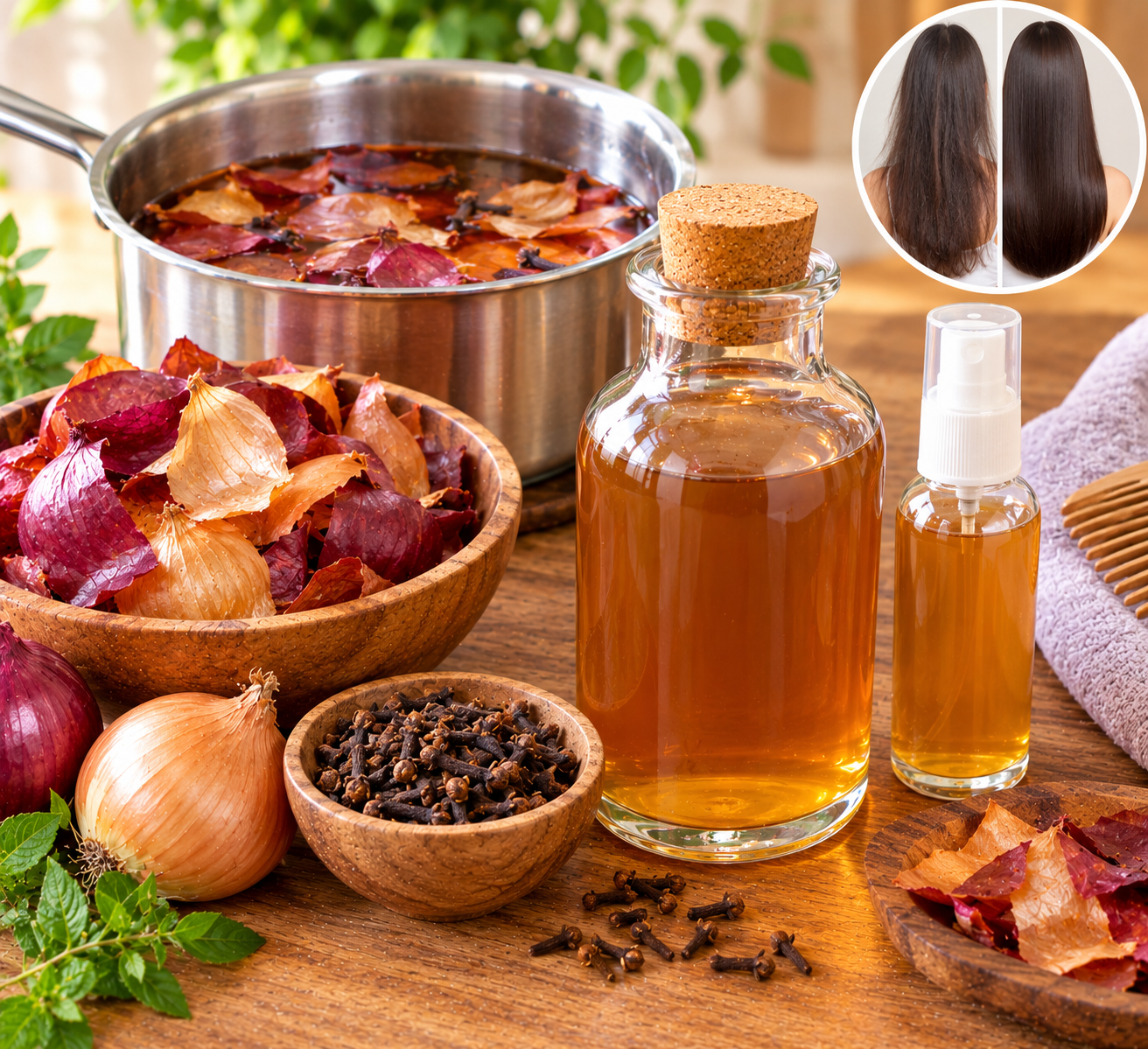
This easy recipe combines dried onion peels and whole cloves to create an aromatic, amber-colored rinse that can be incorporated into a hair care routine. It is inexpensive, simple to prepare, and uses ingredients that are readily available in many kitchens.
But here is something important to remember: although natural ingredients can be interesting to explore, there is no reliable evidence that an onion-peel-and-clove rinse can regrow a bald spot in just 16 days. Hair loss has many possible causes, and the right treatment depends on the reason behind it.
Ingredients
You will need:
- 1 handful of clean, dry red or yellow onion peels
- 1 teaspoon of whole cloves
- 2 cups (approximately 500 ml) of water
Optional equipment:
- A small saucepan
- A fine-mesh strainer
- A clean glass container
- A clean spray bottle
Instructions
Step 1: Prepare the ingredients
Collect clean onion peels and remove any pieces that are moldy, dirty, or damaged. Measure the cloves and set them aside.
Step 2: Heat the water
Pour 2 cups of water into a small saucepan and bring it to a gentle boil.
Step 3: Add the onion peels
Add the onion peels to the water and reduce the heat. Allow them to simmer gently for approximately 10 minutes.
Step 4: Add the cloves
Add the whole cloves and continue simmering for another 5 minutes.
Step 5: Let the mixture cool
Remove the saucepan from the heat and allow the liquid to cool completely.
Step 6: Strain the liquid
Pour the mixture through a fine-mesh strainer to remove all the solid ingredients.
Step 7: Store safely
Transfer the cooled liquid into a clean container. Keep it refrigerated and prepare small batches rather than storing it for long periods. Discard it if its smell, color, or appearance changes.
Methods of Application
If you choose to try this rinse as part of your hair care routine, follow these precautions:
- Test a small amount on a limited area of skin first and wait 24–48 hours.
- Do not apply it to irritated, broken, inflamed, or infected skin.
- Avoid contact with your eyes.
- Do not leave it on your scalp if you experience burning, itching, redness, or swelling. Rinse it off immediately.
- Do not mix it with essential oils, garlic juice, strong chemicals, or other irritating ingredients.
Because homemade rinses are not standardized or clinically tested, there is no established application schedule or proven dose for hair regrowth.
History of Onion Peels and Cloves in Hair Care
Onions have been used in traditional cooking and household remedies for generations. Their outer skins are often saved for cooking, coloring, or other home uses.
Cloves, the dried flower buds of the clove tree, have a long history in traditional food preparation and herbal practices. They are known for their distinctive aroma and contain compounds such as eugenol.
Over time, social media has popularized combinations of onion peels, cloves, rosemary, and other kitchen ingredients as homemade hair treatments. However, traditional use does not automatically establish that a remedy works, and the specific combination described here has not been proven to reverse baldness.
Potential Benefits for a Hair Care Routine
1. An inexpensive homemade option
Both ingredients are commonly available, making this recipe affordable for people interested in traditional beauty practices.
2. A simple herbal preparation
The ingredients can be simmered in water without complicated equipment or preparation techniques.
3. An opportunity to establish a hair care routine
Gentle hair care, regular washing, conditioning, and avoiding excessive heat or tight hairstyles can help protect fragile hair from damage.
4. An introduction to traditional ingredients
Preparing this rinse can be a way to learn about familiar household ingredients and their historical uses.
Important distinction: These are practical or cosmetic aspects of the recipe, not proof that it stimulates new hair growth. Cloves and onion peels have not been established as an effective treatment for hereditary baldness.
Hair Growth and the Science Behind It
Hair grows from follicles in the skin through a natural cycle of growth, transition, and resting. The speed and thickness of growth vary from person to person.
A photograph showing more hair after 16 days cannot, by itself, establish that a homemade rinse caused the change. Lighting, camera angles, existing fine hairs, and other factors can affect how hair appears.
There is limited research on certain other natural remedies, including onion juice for a specific type of patchy hair loss. Those findings cannot be assumed to apply to onion peels mixed with cloves. More research is needed to establish safety and effectiveness.
If you have a bald patch, a receding hairline, or ongoing hair loss, a dermatologist can help identify the cause and discuss evidence-based treatment options. Early assessment can be especially helpful when hair loss is sudden or patchy.
Precautions and Safety Tips
- Never assume that a natural ingredient is automatically safe for everyone.
- Avoid using the rinse if you have a known allergy to any ingredient.
- Do not apply concentrated clove essential oil directly to the scalp.
- Do not use this mixture as a substitute for medical evaluation or a prescribed treatment.
- Seek medical advice if you develop a sudden bald patch, scalp pain, scaling, redness, or rapid hair loss.
Conclusion
Onion peels and cloves offer a simple way to explore traditional homemade hair care, using two familiar ingredients and a straightforward preparation method.
While this rinse may interest people who enjoy natural beauty routines, it should not be presented as a guaranteed cure for baldness or a treatment that produces dramatic results in 16 days. Healthy hair care begins with protecting the scalp, avoiding unnecessary damage, and understanding the cause of hair loss.
Remember, the best approach is one that is safe, realistic, and suited to your individual needs.