Introduction
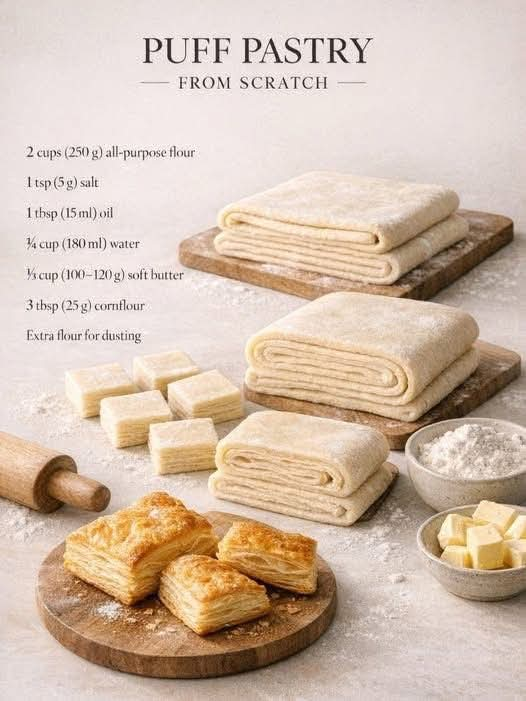
Making puff pastry from scratch is easier than it may seem. With just flour, salt, water, butter, and a little patience, you can create beautifully flaky pastry with hundreds of delicate layers. When baked, the butter melts between the layers while the water in the dough turns into steam, creating that characteristic golden, crisp, airy texture.
Homemade puff pastry is perfect for both sweet and savory recipes: croissants, turnovers, palmiers, meat pies, cheese pastries, fruit tarts, and many other delicious creations.
🧾 Ingredients
For the dough
- 2 cups (250 g) all-purpose flour
- 1 teaspoon (5 g) salt
- 1 tablespoon (15 ml) vegetable oil
- ¾ cup (180 ml) cold water, approximately
For the butter layer
- ½ cup (100–120 g) soft butter
- 3 tablespoons (25 g) corn flour/cornstarch
- Extra flour, for dusting
Tip: For the best results, use good-quality unsalted butter. The butter should be soft enough to spread but not melted.
👩🍳 Instructions
1. Prepare the dough
In a large bowl, combine the flour and salt. Add the oil and gradually pour in the water while mixing.
Knead until you have a smooth, soft dough. Avoid adding too much water—the dough should come together without becoming sticky.
Shape it into a ball, cover it, and let it rest for 20–30 minutes.
2. Prepare the butter mixture
Place the softened butter in a bowl and mix it with the corn flour until smooth and spreadable.
The corn flour helps make the butter mixture easier to work with and contributes to a delicate pastry texture.
3. Roll the dough
Lightly flour your work surface.
Roll the rested dough into a rectangle, approximately 3–4 mm thick.
Spread a thin, even layer of the butter mixture over the surface, leaving a small border around the edges.
4. Make the first fold
Fold the dough into thirds, like folding a letter:
- Fold the bottom third toward the center.
- Fold the top third over it.
- Turn the dough 90 degrees.
This is your first fold.
5. Repeat the folding
Roll the dough gently into a rectangle again and fold it into thirds.
Repeat the rolling and folding process 3–4 times, keeping the dough and butter cool.
If the butter begins to soften or leak out, stop and refrigerate the dough for 15–20 minutes before continuing.
6. Rest the pastry
After the final fold, wrap the dough well and refrigerate it for at least 1 hour.
For even better flavor and texture, you can refrigerate it overnight.
7. Shape and use
Roll the chilled pastry to your desired thickness and cut it according to your recipe.
You can use it to make:
- 🥐 Croissants
- 🍎 Apple turnovers
- 🧀 Cheese pastries
- 🍫 Chocolate pastries
- 🥧 Savory pies
- 🍓 Fruit pastries
- 🌰 Nut-filled pastries
- 🥩 Meat pastries
- 🥨 Palmiers
🔥 Baking Method
Preheat your oven to approximately 200°C (400°F).
Place the prepared pastries on a baking sheet lined with parchment paper.
For a beautiful golden finish, brush the surface with beaten egg if desired.
Bake until the pastry has risen dramatically and become deeply golden and crisp, usually around 15–25 minutes, depending on the size and shape.
Avoid opening the oven too frequently because the temperature drop can interfere with the pastry’s rise.
🥐 The Formation of the Layers
The magic of puff pastry comes from its layers.
When you roll and fold the dough repeatedly, you create alternating layers of dough and butter. During baking, the water contained in the butter and dough turns into steam. The steam pushes the layers apart, producing the characteristic flaky structure.
That is why keeping the butter cool but workable is so important. If the butter melts into the dough before baking, the layers can disappear and the pastry may become dense rather than flaky.
📜 History of Puff Pastry
Puff pastry has a long culinary history and developed through European pastry traditions, with particularly strong associations with French pastry-making.
Over generations, pastry chefs refined techniques involving thin layers of dough and butter to create pastries that rise dramatically in the oven.
Today, puff pastry is one of the most versatile pastry preparations in the world and is used in countless sweet and savory dishes.
🌟 Benefits of Homemade Puff Pastry
Making puff pastry at home offers several advantages:
- You control the ingredients.
- You can choose high-quality butter.
- You can avoid unnecessary preservatives found in some packaged products.
- Fresh pastry has a wonderful buttery aroma.
- You can prepare the dough in advance.
- One batch can be used for many different recipes.
- Homemade pastry can be customized for sweet or savory dishes.
Of course, puff pastry is a rich food because it contains butter and flour, so it is best enjoyed as part of a balanced diet.
💡 Important Tips for Perfect Puff Pastry
Keep everything cool
Warm butter is one of the biggest enemies of flaky pastry. Refrigerate the dough whenever necessary.
Don’t overwork the dough
Knead only until the dough becomes smooth. Excessive handling can make it tough.
Roll gently
Use even pressure when rolling so that you don’t squeeze the butter completely out of the layers.
Flour lightly
Use enough flour to prevent sticking, but brush away excess flour before folding.
Give the dough time to rest
Resting allows the gluten to relax and makes the pastry easier to roll.
Bake in a fully preheated oven
A hot oven is essential for producing the steam needed to lift the layers.
❤️ Serving Ideas
Fresh homemade puff pastry can become an incredible centerpiece for breakfast, dessert, or dinner.
Try filling it with:
Sweet fillings
- Apples and cinnamon
- Strawberries and cream
- Chocolate
- Nutella
- Custard
- Pears and almonds
- Jam and cream cheese
Savory fillings
- Ham and cheese
- Chicken and mushrooms
- Spinach and cheese
- Ground beef
- Tuna and vegetables
- Brie and cranberry
🧊 Storage
Unbaked puff pastry can be wrapped tightly and refrigerated for approximately 2–3 days.
It can also be frozen. Wrap it carefully in plastic wrap and place it in a freezer-safe bag or container.
When ready to use, thaw it in the refrigerator rather than at room temperature. This helps keep the butter firm and protects the layers.
🥰 Why Lovers of Homemade Pastry Will Love It
If you love pastries with a crisp golden exterior, buttery aroma, and delicate flaky layers, homemade puff pastry is absolutely worth trying.
The process takes patience, but the result is incredibly satisfying. There’s something special about taking a few simple ingredients and transforming them into a pastry that rises into dozens of beautiful layers in the oven.
🏆 Conclusion
Homemade Puff Pastry from Scratch is a classic kitchen project that rewards patience and careful technique. The key is simple: good butter, properly rested dough, gentle rolling, careful folding, and keeping everything cool.
Once you’ve mastered this basic pastry, you’ll have a versatile homemade dough ready for everything from elegant desserts to comforting savory pastries.