Introduction
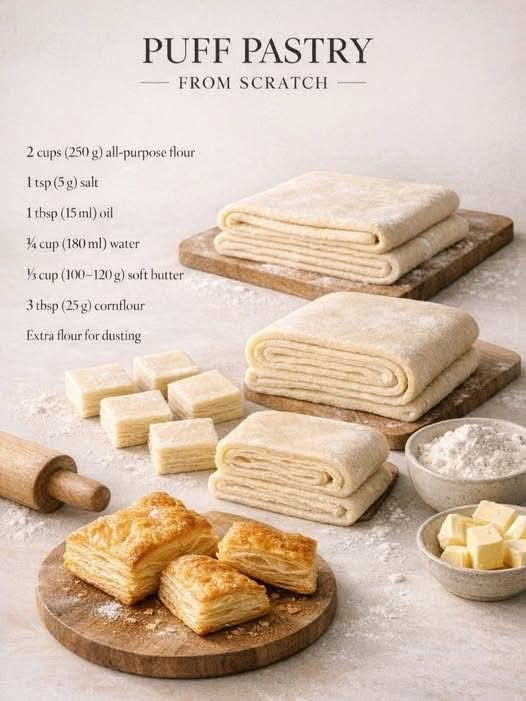
Homemade puff pastry is one of those classic recipes that looks complicated but becomes surprisingly manageable once you understand the technique. With just flour, salt, water, oil, butter, and cornflour, you can create a beautifully flaky pastry with hundreds of delicate layers.
The secret is layering butter between thin sheets of dough and repeatedly folding and rolling it. During baking, the water in the butter and dough turns into steam, pushing the layers apart and creating that characteristic golden, crisp, airy texture.
This homemade puff pastry is perfect for croissants, turnovers, cheese twists, sausage rolls, savory pastries, fruit pastries, palmiers, tarts, and many other delicious creations.
Recipe Information
Recipe: Homemade Puff Pastry
Cuisine: French-inspired
Preparation: 35–45 minutes
Chilling: 1½–2 hours
Baking: Depends on the recipe using the pastry
Difficulty: Moderate
Yield: About 500–600 g pastry
Ingredients
For the Dough
- 2 cups (250 g) all-purpose flour
- 1 teaspoon (5 g) salt
- 1 tablespoon (15 ml) oil
- ¾ cup (180 ml) cold water, or as needed
For the Butter Layer
- ½ cup (100–120 g) soft butter
- 3 tablespoons (25 g) cornflour/cornstarch
- Extra flour, for dusting
Optional
- A little flour for the work surface
- Cold water, if the dough feels too dry
- Egg wash for pastries made with the finished dough
Instructions
1. Prepare the Dough
Place the flour and salt in a large mixing bowl.
Add the oil and gradually pour in the water while mixing. Stir until a rough dough begins to form.
Transfer the dough to a lightly floured surface and knead gently for about 5–7 minutes.
The dough should become smooth and elastic.
Avoid adding too much flour. The dough should be soft but not sticky.
Shape it into a ball.
Make a shallow cross on top of the dough with a knife. Cover it with plastic wrap or a clean kitchen towel and refrigerate for about 20–30 minutes.
2. Prepare the Butter Mixture
Place the softened butter in a bowl.
Add the cornflour and mix thoroughly until you have a smooth, spreadable butter mixture.
The cornflour helps make the butter easier to work with and can help create distinct pastry layers.
Do not melt the butter. It should remain soft but firm enough to spread.
3. Roll Out the Dough
Remove the chilled dough from the refrigerator.
Place it on a lightly floured surface.
Roll it into a rectangle approximately 3–4 mm thick.
Try to keep the edges as straight and even as possible.
Brush away excess flour from the surface.
4. Add the Butter
Spread the butter mixture evenly over approximately two-thirds of the dough, leaving a small border around the edges.
Do not apply the butter too thickly in one place.
The butter should form a relatively even layer.
5. First Fold
Fold the unbuttered third of the dough toward the center.
Then fold the opposite buttered third over it, creating a neat three-layer rectangle.
Press the edges gently to seal them.
This is your first fold.
Wrap the dough and refrigerate it for about 20–30 minutes.
6. Roll Again
Place the chilled dough on a lightly floured surface.
Roll it gently into a long rectangle.
Always roll in one direction as much as possible.
If the butter starts becoming soft or leaking out, stop immediately and refrigerate the dough.
Keeping the butter cold is one of the most important secrets to successful puff pastry.
7. Second Fold
Fold the dough into thirds again:
- Fold one end toward the center.
- Fold the other end over it.
- Gently press the edges together.
Wrap and refrigerate for another 20–30 minutes.
8. Repeat the Folding
Repeat the rolling and folding process 2–3 more times, chilling the dough between folds.
You want to create many thin layers of dough and butter.
Do not rush this process.
The dough should remain cold throughout the preparation.
9. Final Rest
After the final fold, wrap the pastry tightly.
Refrigerate it for at least 30 minutes, preferably longer.
For the best texture, you can refrigerate it for several hours or overnight.
10. Use the Puff Pastry
When you’re ready to bake, remove the pastry from the refrigerator.
Roll it gently to your desired thickness.
Cut it into squares, rectangles, circles, or strips depending on the recipe.
Use a sharp knife or pastry cutter to avoid crushing the layers.
Place the prepared pastries on a baking tray lined with parchment paper.
For a beautiful golden finish, brush the surface with beaten egg if desired.
Baking Method
The exact baking temperature depends on what you are making.
For most puff pastry preparations, a hot oven around 200–220°C (400–425°F) works well.
The high heat helps the butter create steam quickly, which pushes the layers upward.
Bake until the pastry is:
- Golden brown
- Crisp
- Well-puffed
- Dry and flaky
Avoid opening the oven too frequently while the pastry is rising.
Preparation Methods
Method 1: Traditional Folding
The traditional method consists of repeatedly rolling and folding the dough.
This method produces beautifully defined layers and is ideal for:
- Pastry shells
- Turnovers
- Palmiers
- Cheese twists
- Fruit pastries
- Savory appetizers
Method 2: Overnight Method
For even better flavor and easier handling, prepare the dough in advance and let it rest overnight in the refrigerator.
The longer resting time allows the gluten to relax, making the pastry easier to roll.
Method 3: Freezer Method
The finished puff pastry can also be wrapped tightly and frozen.
When you want to use it, transfer it to the refrigerator and allow it to thaw gradually.
The Formation of the Layers
The beautiful structure of puff pastry comes from alternating layers of dough and butter.
When the pastry enters a hot oven, the water contained in the dough and butter turns into steam.
The steam pushes against the layers, separating them.
At the same time, the butter melts and helps create the rich flavor and crisp texture.
This is what gives puff pastry its famous:
✨ Flaky layers
✨ Crisp exterior
✨ Light interior
✨ Golden color
✨ Buttery flavor
The more carefully the dough is rolled and folded, the more defined the layers can become.
History of Puff Pastry
Puff pastry has a long history connected to European pastry traditions, particularly French cuisine.
The technique developed around the idea of creating pastry with multiple thin layers of dough and fat. French pastry chefs refined the method over time and turned laminated dough into an important part of classical pastry making.
Puff pastry eventually became famous throughout Europe and was used in both sweet and savory dishes.
Today, it remains one of the most versatile pastry doughs in the world.
It can be found in everything from elegant French pastries to simple homemade cheese rolls.
Benefits of Homemade Puff Pastry
Although puff pastry is an indulgent food rather than an everyday health food, making it yourself has several practical advantages.
1. Simple Ingredients
You control exactly what goes into the pastry.
2. No Unnecessary Additives
Homemade pastry can be made without preservatives or unnecessary commercial ingredients.
3. Fresh Flavor
Fresh butter and freshly prepared dough provide excellent flavor.
4. Versatility
One batch can be transformed into numerous sweet and savory recipes.
5. Customizable
You can adjust the thickness, shape, and filling according to your recipe.
6. Make-Ahead Friendly
Puff pastry can be refrigerated or frozen for later use.
Tips for Perfect Puff Pastry
Keep Everything Cool
Cold butter is essential. If the butter becomes too soft, the layers can disappear.
Don’t Overwork the Dough
Knead only until the dough becomes smooth and elastic.
Roll Gently
Use even pressure when rolling.
Don’t Add Too Much Flour
Excess flour can make the pastry dry and tough.
Chill Between Folds
Refrigerating the dough gives the butter time to firm up and allows the gluten to relax.
Don’t Crush the Edges
When cutting the pastry, use a sharp knife and avoid pressing down heavily.
Use a Hot Oven
Puff pastry needs strong heat to create steam and lift the layers.
Don’t Open the Oven Too Early
Opening the oven can cause the pastry to lose heat and may interfere with its rise.
Delicious Ways to Use Homemade Puff Pastry
Your homemade pastry can be used to make:
🥐 Croissants
🍎 Apple turnovers
🍓 Fruit pastries
🧀 Cheese twists
🍫 Chocolate pastries
🥓 Savory pinwheels
🥧 Tart shells
🌭 Sausage rolls
🍯 Palmiers
🥐 Cream-filled pastries
🧅 Caramelized onion pastries
🍅 Tomato and cheese tartlets
Serving Suggestions
Freshly baked puff pastry is best served warm or at room temperature.
For sweet pastries, serve with:
- Fresh berries
- Whipped cream
- Powdered sugar
- Chocolate
- Caramel sauce
- Vanilla cream
- Jam
For savory pastries, serve with:
- Cheese
- Eggs
- Roasted vegetables
- Chicken
- Ham
- Creamy dips
- Fresh salad
Storage
Refrigerator
Wrap unbaked puff pastry tightly and refrigerate for up to 2–3 days.
Freezer
For longer storage, wrap the pastry very well and freeze it.
Thaw it slowly in the refrigerator before rolling and using.
Baked Pastries
Store baked pastries in an airtight container for a short period. Reheat them in the oven to restore some of their crispness.
Avoid microwaving if you want to maintain the flaky texture.
Common Mistakes
Butter Melts During Rolling
Solution: Put the dough back into the refrigerator before continuing.
Dough Keeps Shrinking
Cause: The gluten has not relaxed enough.
Solution: Let the dough rest in the refrigerator for longer.
Pastry Doesn’t Puff
Possible causes: Butter became too warm, layers were crushed, or the oven wasn’t hot enough.
Pastry Is Tough
Possible cause: Too much flour or excessive kneading.
Butter Leaks Out
Solution: Chill the pastry immediately and continue only once the butter has firmed up.
Why You Will Love This Recipe ❤️
This homemade puff pastry is worth the effort because it gives you a completely different experience from ordinary store-bought pastry.
You get to control the ingredients, create the layers yourself, and enjoy that wonderful moment when the pastry rises dramatically in the oven.
The finished pastry is golden, crisp, buttery, delicate, and wonderfully flaky.
It is also an excellent recipe to learn because once you master the basic technique, you can use it to create dozens of impressive dishes.
Conclusion
Making puff pastry from scratch may seem intimidating at first, but the process is really about three simple principles:
Cold butter + gentle rolling + proper folding.
Take your time, keep the dough chilled, and avoid rushing the folds.
With practice, you’ll be able to create beautiful homemade puff pastry with crisp, delicate layers and a rich buttery flavor.
Whether you use it for a sweet dessert, a savory appetizer, a breakfast pastry, or an elegant tart, this homemade puff pastry is a wonderful recipe to keep in your kitchen.