Introduction
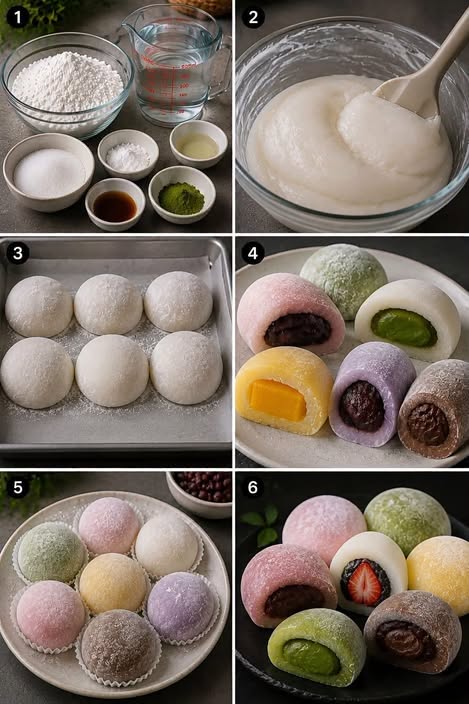
Mochi is a beloved Japanese sweet made from glutinous rice flour, known for its wonderfully soft, stretchy, and chewy texture. Although traditional mochi is made by steaming and pounding cooked glutinous rice, this homemade version uses sweet rice flour to make the process much easier.
The beauty of homemade mochi is its versatility. You can prepare it plain, flavor it with vanilla or matcha, add beautiful colors, and fill each piece with sweet surprises such as red bean paste, strawberries, chocolate, Nutella, peanut butter, ice cream, or sweetened cream.
These little treats are perfect for parties, afternoon desserts, celebrations, or simply when you want something soft, colorful, and delicious.
🍡 Recipe Information
Preparation Time: 15 minutes
Cooking Time: 5–8 minutes
Cooling Time: 10–15 minutes
Total Time: About 35 minutes
Servings: 12–16 mochi
Difficulty: Easy
Texture: Soft, stretchy, chewy
Cuisine: Japanese-inspired dessert
🛒 Ingredients
For the Mochi Dough
- 1 cup glutinous rice flour (sweet rice flour)
- ¾ cup water
- ¼ cup granulated sugar
- 2 tablespoons cornstarch
- 1 tablespoon neutral oil
- 1 teaspoon vanilla extract
- 1–2 teaspoons matcha powder, optional
- Food coloring, optional
- Additional flavoring, optional
- Cornstarch or potato starch, for dusting
For the Filling
Choose one filling or combine several:
- Sweet red bean paste
- Nutella or chocolate spread
- Peanut butter
- Cookie butter
- Sweetened whipped cream
- Cream cheese filling
- Fresh strawberries
- Mango pieces
- Blueberries
- Small scoops of ice cream
- Chocolate ganache
- Coconut cream
- Caramel sauce
Simple Cream Filling
- ½ cup heavy whipping cream
- 2 tablespoons powdered sugar
- ½ teaspoon vanilla extract
Whip everything together until thick and creamy.
🥣 Instructions
Step 1: Prepare the Filling
If using red bean paste, chocolate spread, or another thick filling, divide it into small portions.
For approximately 12–16 mochi, prepare small balls of filling, roughly 1–2 teaspoons each.
If using fresh fruit, cut the fruit into small pieces.
For ice cream mochi, scoop small balls of ice cream onto a tray lined with parchment paper and freeze until very firm.
Step 2: Prepare the Mochi Mixture
In a microwave-safe bowl, combine:
- Glutinous rice flour
- Sugar
- Cornstarch
- Water
Whisk thoroughly until the mixture becomes smooth.
There should be no dry flour remaining.
Add the vanilla extract and neutral oil. Mix again.
If you want matcha mochi, add 1–2 teaspoons of matcha powder and whisk until evenly distributed.
Step 3: Add Color
If desired, add a small amount of food coloring.
For example:
- Green for matcha
- Pink for strawberry
- Yellow for mango
- Purple for blueberry
- Brown for chocolate
Add only a little at a time because the color can become stronger after cooking.
Step 4: Cook the Mochi
Cover the bowl loosely with plastic wrap or a microwave-safe cover.
Microwave for about 1 minute.
Remove carefully and stir thoroughly.
Return to the microwave and cook for another 30–60 seconds.
Stir again.
Continue in short intervals until the mixture becomes thick, sticky, glossy, and stretchy.
The exact cooking time depends on the strength of your microwave.
Important:
The mixture will become extremely hot and sticky, so handle it carefully.
Step 5: Prepare the Work Surface
Generously dust a clean work surface or large baking tray with cornstarch or potato starch.
Transfer the hot mochi dough onto the starch.
Dust the top with more starch.
Allow it to cool enough to handle.
Step 6: Roll Out the Mochi
Using a rolling pin dusted with starch, gently roll the dough into a relatively even sheet.
Aim for approximately ¼ inch thick.
Do not roll it too thin because the dough needs enough strength to hold the filling.
Step 7: Cut the Mochi
Use a round cookie cutter or glass to cut circles from the dough.
Dust the cutter with starch to prevent sticking.
Brush or gently shake off excess starch from each piece.
Step 8: Fill the Mochi
Place approximately 1–2 teaspoons of filling in the center of each mochi circle.
Do not overfill.
Carefully stretch the edges around the filling.
Bring the edges together and pinch them firmly to seal.
Place the sealed side down.
Repeat with the remaining dough.
Step 9: Finish the Mochi
Lightly dust each mochi with cornstarch or potato starch.
Gently remove excess starch with a soft pastry brush.
Your homemade mochi is now ready to enjoy!
🍵 Preparation Methods
Method 1: Microwave Mochi
This is the quickest homemade method.
- Mix the ingredients.
- Microwave.
- Stir.
- Microwave again.
- Continue until thick and stretchy.
- Transfer to a starch-covered surface.
- Roll, cut, fill, and seal.
This method is particularly convenient for beginners.
Method 2: Steamed Mochi
For a more traditional-style preparation:
- Mix the glutinous rice flour, sugar, and water.
- Pour the mixture into a heatproof dish.
- Cover tightly.
- Steam for approximately 20–25 minutes.
- Stir the cooked dough carefully.
- Transfer it to a starch-dusted surface.
- Roll and shape.
- Add your favorite filling.
Steaming produces a soft and pleasantly chewy texture.
🍓 Delicious Filling Ideas
Strawberry Cream Mochi
Fill the mochi with whipped cream and a small fresh strawberry.
The combination of chewy mochi, creamy filling, and juicy fruit is delicious.
Chocolate Mochi
Place a small amount of chocolate spread or ganache inside each mochi.
For extra flavor, add a small chocolate piece in the center.
Matcha Mochi
Add matcha powder to the dough and fill it with sweet red bean paste.
This creates a classic Japanese-inspired combination.
Mango Mochi
Fill the mochi with whipped cream and small pieces of ripe mango.
Nutella Mochi
A spoonful of chocolate-hazelnut spread makes a rich and indulgent filling.
Ice Cream Mochi
Use very firm frozen ice cream balls as the filling.
Work quickly because the ice cream begins to soften once wrapped.
🌸 History of Mochi
Mochi has a long history in Japanese food culture.
Traditional mochi is made from mochigome, a short-grain glutinous rice. The rice is soaked, steamed, and traditionally pounded until it becomes smooth, sticky, and elastic.
This process is known as mochitsuki.
Mochi has been associated with Japanese celebrations, festivals, religious traditions, and New Year customs for centuries.
Over time, many varieties developed, including filled and flavored versions.
Modern mochi can now be found in countless forms, from traditional red bean-filled sweets to colorful fruit mochi and frozen ice cream mochi.
🌿 Benefits of Homemade Mochi
Mochi is primarily a dessert, so it is best enjoyed as part of a balanced diet rather than considered a health food.
Energy
Glutinous rice flour provides carbohydrates, which are an important source of energy.
Simple Ingredients
Homemade mochi allows you to control the ingredients, sweetness, colors, and fillings.
Customizable
You can choose fruit-based fillings, matcha, nuts, chocolate, or lighter cream fillings according to your preference.
Portion-Friendly
Because mochi pieces are naturally small, they can be served individually as bite-sized desserts.
Matcha Option
Adding matcha provides the characteristic green-tea flavor and contributes naturally occurring plant compounds.
✨ Formation and Texture of Mochi
The special texture of mochi comes from glutinous rice flour.
Despite its name, glutinous rice does not contain gluten. The word “glutinous” refers to its sticky, glue-like texture when cooked.
When glutinous rice flour is combined with water and heated, the starch absorbs water and gelatinizes. This creates the characteristic soft, stretchy, and chewy dough.
The sugar contributes sweetness and also helps keep the finished mochi tender.
Oil helps reduce excessive sticking and contributes to a smoother dough.
Cornstarch or potato starch is mainly used on the outside to prevent the sticky dough from attaching to your hands and work surface.
💡 Important Tips for Perfect Mochi
1. Use the Correct Flour
Always use glutinous rice flour, also called sweet rice flour.
Regular rice flour will not produce the same chewy texture.
2. Do Not Add Too Much Filling
Overfilling makes the mochi difficult to close and can cause it to split.
3. Keep the Work Surface Well Dusted
Mochi dough is extremely sticky when warm.
Use enough cornstarch or potato starch to make shaping easier.
4. Do Not Overcook
Overcooking can make the dough excessively firm.
Cook until the mixture is glossy, thick, and stretchy.
5. Let It Cool Slightly
The dough can be extremely hot immediately after cooking.
Allow it to cool enough to handle safely.
6. Use Firm Fillings
Thick fillings are easier to wrap than very liquid fillings.
7. Work Quickly With Ice Cream
For ice cream mochi, keep the ice cream frozen until the last possible moment.
🍵 Serving Suggestions
Serve mochi with:
- Green tea
- Matcha latte
- Japanese tea
- Coffee
- Hot chocolate
- Fresh fruit
- A scoop of ice cream
For parties, arrange several colors and flavors on a serving platter.
A combination of strawberry, matcha, mango, chocolate, and vanilla mochi creates a beautiful dessert selection.
❄️ Storage
Homemade mochi is best enjoyed fresh because its texture can change as it sits.
Store filled mochi in an airtight container.
Separate pieces with parchment paper if necessary to prevent them from sticking together.
For fruit or cream-filled mochi, refrigeration may be necessary depending on the filling.
Ice cream mochi should remain frozen.
Allow frozen mochi to sit at room temperature for a few minutes before serving so the outer dough becomes pleasantly soft.
❤️ Why Mochi Lovers Love This Recipe
Mochi lovers appreciate this dessert because every bite offers a unique combination of textures.
The outside is:
soft + chewy + stretchy
while the center can be:
creamy + fruity + chocolaty + nutty
The recipe is also incredibly customizable. One basic dough can become several different desserts simply by changing the flavor, color, and filling.
🍡 Variations
🌿 Matcha Mochi
Add matcha powder to the dough and use red bean paste.
🍓 Strawberry Mochi
Add strawberry flavoring or coloring and fill with cream and fresh strawberry.
🍫 Chocolate Mochi
Add cocoa powder to the dough and fill with chocolate ganache.
🥭 Mango Mochi
Use mango flavoring and fill with fresh mango and whipped cream.
🫐 Blueberry Mochi
Add blueberry flavoring and coloring and fill with blueberry cream.
🥥 Coconut Mochi
Add coconut flavoring and fill with sweet coconut cream.
🍽️ Final Conclusion
Homemade mochi is a wonderfully fun dessert that combines a soft, chewy exterior with almost endless filling possibilities. With just a few basic ingredients, you can create colorful and delicious treats that look impressive while remaining surprisingly simple to prepare.
The secret is using glutinous rice flour, cooking the mixture until it becomes stretchy and glossy, and working with plenty of starch to control the stickiness.
Whether you choose classic red bean paste, creamy strawberries, rich chocolate, tropical mango, matcha, or even ice cream, homemade mochi is a delightful dessert that can be customized for almost any occasion.