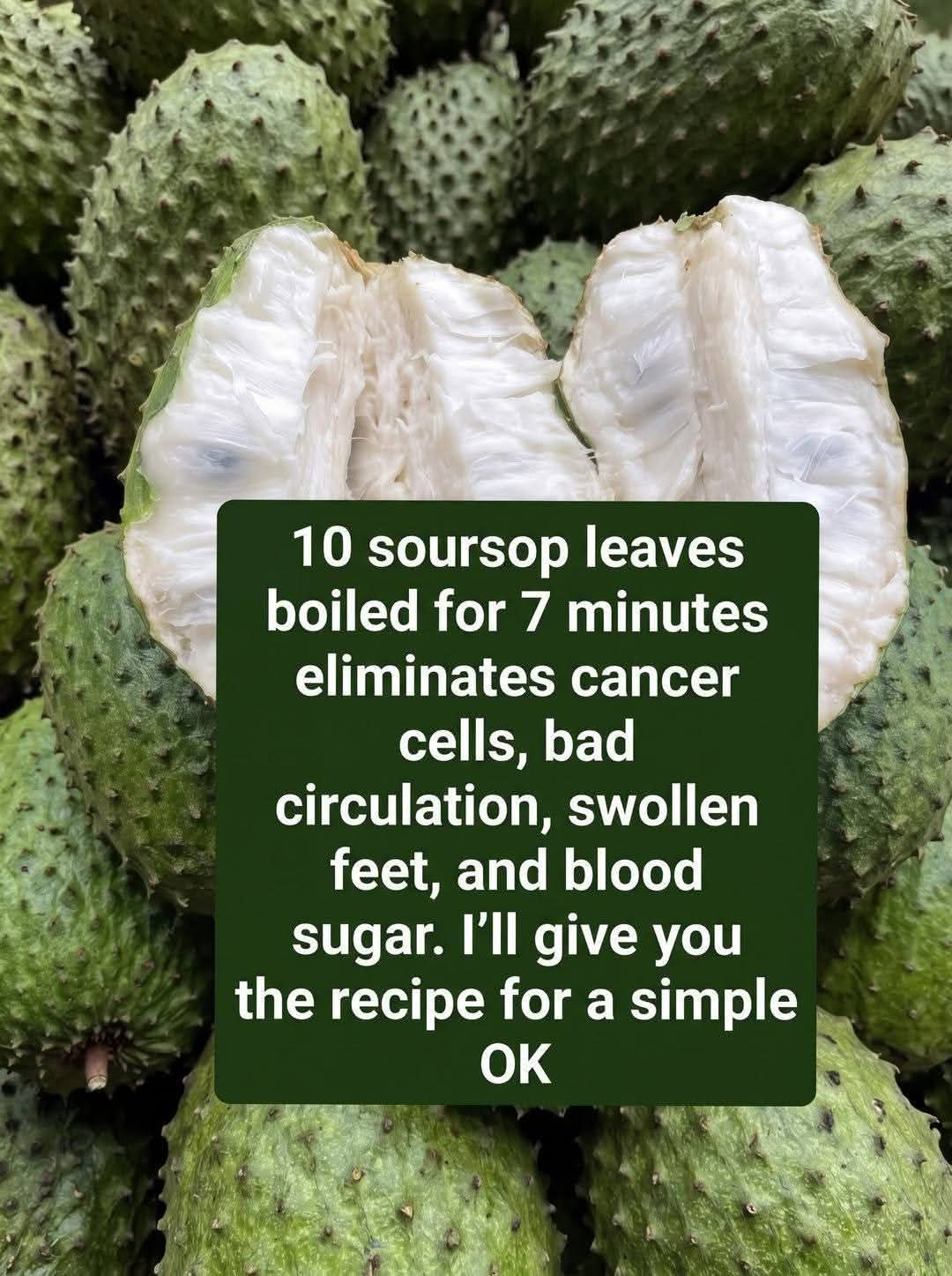
Important note: The image claims that boiled soursop leaves can “eliminate cancer cells,” cure poor circulation, swollen feet, and control blood sugar. These claims are not established by good-quality human clinical evidence. Laboratory research has found interesting compounds in soursop (Annona muricata), but that does not mean the leaf tea treats or cures cancer. Some soursop preparations may also contain potentially neurotoxic compounds, and a safe long-term intake has not been established.
🌿 Introduction
Soursop, also known as graviola or guanábana, is a tropical fruit traditionally used in different parts of the world. Besides its sweet, creamy fruit, the leaves have traditionally been prepared as herbal infusions.
This recipe presents soursop leaves as a traditional herbal drink, not as a medicine or replacement for medical treatment. Research into soursop is still ongoing: laboratory studies have observed biological activity from compounds in the plant, including effects on cancer cells in laboratory models, but evidence from humans is insufficient to establish it as a cancer treatment.
🍃 Ingredients
For a simple traditional infusion
- 5–10 fresh, clean soursop leaves
- 1 liter of drinking water
- 1 small piece of fresh ginger — optional
- A few drops of lemon juice — optional
- Honey — optional, added after cooling
Important: Using 10 leaves does not make the drink a proven cancer treatment. There is no scientifically established recipe showing that boiling exactly 10 leaves for 7 minutes eliminates cancer cells.
🫖 Instructions
Step 1 — Prepare the leaves
Choose clean, healthy-looking soursop leaves. Wash them thoroughly under running water to remove dirt and other residue.
Step 2 — Heat the water
Place approximately 1 liter of water in a saucepan and bring it to a gentle boil.
Step 3 — Add the leaves
Add the washed leaves to the hot water.
Step 4 — Simmer gently
Reduce the heat and allow the leaves to simmer gently for several minutes.
Step 5 — Strain
Remove the saucepan from the heat and strain the liquid through a clean strainer.
Step 6 — Serve
Allow the drink to cool to a comfortable temperature. If desired, add a little lemon or honey for flavor.
🌿 Preparation Method
The traditional method is essentially a leaf decoction:
- Wash the leaves.
- Heat the water.
- Add the leaves.
- Simmer gently.
- Strain.
- Drink as a traditional herbal beverage.
However, the concentration of compounds in soursop leaves can vary considerably depending on the plant, growing conditions, harvesting, and preparation method. Consequently, a homemade tea cannot be treated as a standardized medicinal dose.
📜 History & Traditional Use
Soursop (Annona muricata) originates from tropical regions of the Americas and is now cultivated in many tropical areas.
The fruit is widely appreciated as food, while different parts of the plant—including leaves, bark, roots, and fruit—have been used traditionally in herbal practices.
Modern scientific research has investigated soursop because it contains numerous plant compounds, particularly acetogenins, alkaloids, flavonoids, and phenolic compounds. Some laboratory experiments have demonstrated biological activity, including activity against cancer cell lines.
But there is an important distinction:
Laboratory activity ≠ proven treatment in humans.
💚 Possible Benefits
Soursop leaves contain various naturally occurring compounds that researchers are studying.
1. Antioxidant potential
Some compounds found in soursop have antioxidant activity in laboratory research.
2. Traditional herbal use
Soursop leaves have a long history of use in traditional preparations.
3. Scientific research interest
Extracts from soursop leaves have demonstrated effects on certain cancer cells in laboratory studies, which is one reason researchers continue investigating the plant.
4. A warm, caffeine-free beverage
A simple leaf infusion can be enjoyed as an herbal drink without caffeine.
⚠️ What it has NOT been proven to do
There is currently no good evidence that soursop-leaf tea:
- eliminates cancer from the body
- cures diabetes
- removes “bad circulation”
- treats swollen feet
- replaces chemotherapy or other cancer treatment
- reliably lowers blood sugar in people
Some studies have actually raised safety concerns about prolonged or excessive exposure to soursop preparations because of potentially neurotoxic acetogenins.
⚠️ Safety Information
This is the most important part of the recipe.
Because the safe dose and long-term safety of soursop-leaf preparations have not been established, avoid treating this tea as a daily medicinal cure.
People who are taking medication—especially cancer medicines or medicines affecting blood sugar or blood pressure—should speak with a doctor or pharmacist before using soursop-leaf preparations. Potential herb–drug interactions are an area of ongoing research.
If someone has cancer, they should never stop chemotherapy, radiation, surgery, immunotherapy, or prescribed medication in favor of soursop tea.
Swollen feet and poor circulation can also have many causes, some of which require medical evaluation.
🍋 Optional Flavor Variations
Soursop & Ginger
Add a small piece of fresh ginger while preparing the infusion for a warmer, spicier flavor.
Soursop & Lemon
Allow the tea to cool slightly and add fresh lemon juice.
Light Herbal Blend
A small amount of mint can be added for a refreshing flavor.
These additions are for taste, not for treating disease.
🌱 Formation of the Recipe
The recipe follows a simple traditional herbal-tea structure:
Fresh leaves → washing → hot water → gentle simmering → straining → cooling → serving
The goal is to produce a mild herbal infusion rather than a concentrated extract.
❤️ For Herbal-Tea Lovers
If you enjoy traditional herbal beverages, this soursop-leaf infusion can be an interesting addition to your collection. Its appeal comes from its tropical origin and long history of traditional use.
But the healthiest approach is to enjoy it as a beverage rather than as a miracle cure.
🍵 Serving Suggestions
Serve it:
- Warm in a small cup
- Chilled over ice
- With lemon for freshness
- With a small amount of honey for sweetness
- Alongside a balanced meal
For someone managing diabetes, avoid adding sugar or honey without considering their overall carbohydrate intake.
🧊 Storage
For food-safety reasons, refrigerate leftover herbal tea promptly in a clean, covered container and use it soon rather than keeping it for many days.
For best flavor, prepare a fresh batch rather than making a large quantity for prolonged storage.
🌿 Conclusion
Soursop leaves have an interesting history in traditional herbal practices, and modern researchers are studying their plant compounds. Some laboratory studies have produced intriguing findings, including effects on cancer cells, but there is not enough human evidence to say that soursop-leaf tea eliminates cancer or treats other diseases.
So, if you want to prepare this drink, think of it as a traditional herbal infusion, not a cancer cure or diabetes treatment. Because potential neurotoxicity and other safety uncertainties have been reported, particularly with prolonged use, moderation and medical advice are important.